It's always seemed so simple: reading more novels equals becoming more intelligent. But novel reading hasn't always had such a clear verdict, previously thought of as a hobby threatening social morality and causing brain rot. With so many different forms of entertainment that compete in the modern developed world, reading of any form seems to have gone from a social problem to a greatly valued, highbrow activity that is essential for the production of great thinkers. But are there actually firm benefits to reading in children, or are these attitudes the result of a misguided stereotype that merely elevates the educated above the uneducated?
If you just take a look around, it's clear that today's children live much of their lives behind the bright lights of screens, be they computer screens, televisions, smart phones, et cetera. It's a new phenomenon, and the concern about it is understandable. An excess of highly stimulating activities such as television watching, for example, have been directly correlated to childhood obesity in some studies, and too many video games have a well-known relationship with attention deficit hyperactivity disorder in others. Now I know what you might be thinking, and I can assure you that I'm not trying to shame you into cancelling your cable subscription or internet connection (I mean, how else am I supposed to find out who gets kicked off of Master Chef next week if that's the case?), nor do I want to dismiss any of the proven benefits of technology to children. But what reading (and reading for pleasure in particular) does is provide an opportunity for children to be quiet, subdued, and happy which are three qualities that don't seem to be married often among today's youth. Speaking from my own experience, the subtle pleasures of reading are what developed my ability to focus without depending on flashing lights to hold my attention.


Reading for pleasure has also been proven as one of the best ways to develop an abundance of additional skills such as vocabulary development, better spelling, and even the ability to learn additional languages with more ease. These communication skills are especially important among the technological revolution that we face; more people are able to connect in the workforce than ever before despite geographical restrictions through virtual teams making the ability to read and write well essential for professional success.
Again, it's not that other forms of entertainment are necessarily detrimental to a child's development, but reading for pleasure does develop skills that other mediums may not hone quite as well. So, how do we turn a child's interest towards reading among all of the highly stimulating activities that compete for his or her attention? I believe that the answer is not shunning the digital world in favour of books (indeed, that very well might make a child crave the digital in place of the non-digital even more), but rather connecting the two. For example, say a child likes StarCraft; he or she may also be interested in the books that supplement the game and delve deeper into the story line. Beyond that, he or she may also be interested in books that have similar elements like themes of military strategy/science fiction genre/ominous tone/fast pace such as:
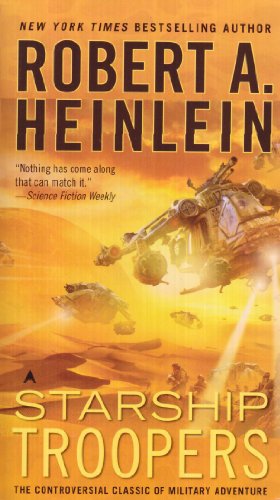
Starship Troopers by Robert A. Heinlein
This futuristic military science fiction novel for teens is narrated by Johnnie, a young soldier whose life unfolds among an interstellar war between mankind and "The Bugs". And, of course, there is a well-known movie of the same name which you may enjoy watching after you are finished.
The Dangerous Days of Daniel X by James Patterson
Fifteen-year-old Alien Hunter Daniel is in charge of exterminating extraterrestrial outlaws, but his job quickly puts Earth and another planet at stake. This science fiction novel is action-packed, fast-paced, and suspenseful.

Dragon and Thief: A Dragonback Adventure by Timothy Zahn
This action-packed suspense thriller follows fourteen-year old Jack who, after being falsely accused of theft, flees to a remote planet and develops a friendship with a dragon warrior where his adventure has only just begun. This is the first book in the Drangonback series.

I think it's all too easy for reading to become a chore, and who wants to do chores when there's a party going on inside the computer? So it's important for us to find indirect ways to encourage children to read for their own personal pleasure in order to develop a positive association with it.
This post includes just a tiny fragment of the debate on why and how children should be encouraged to read. What do you think? Are mandatory reading times essential habit-forming strategies, for example, or should we let children discover the world of print more or less on their own? Do you think the act of reading is all it's cracked up to be, or do digital activities like gaming and movie-going develop an equal amount of positive skills? Let's talk about it.

Here's my opinion as a step-mom to a 14 year old and mother to a 2 year old. I think mandatory reading time is a great way to foster the love of books, but that too much can have the opposite effect. However, combined with incentives it's how I taught my then five year old step son read. Every so many pages I would write a reward, movies, a sleepover, trip to the beach, etc. He still enjoys reading, but only certain genres and I think that's OK.
ReplyDeleteWith my two year old I began reading to her every night and at first it was a disaster, she'd be mad that her door was closed and she couldn't go downstairs to play, however, after a period of time she began periodically sitting in my lap and listening to me read while looking at the pictures. This behaviour eventually turned into her being excited to read and climbing into my lap with a book for up to 45 minutes at a time! She LOVES books now, and I often find her in a pile of them looking at the pictures and babbling to herself about the story.
Those seem like great ideas, Michelle! Was your stepson a reluctant reader at first? How do you think reading transformed from something he had to do (to get his reward) to something he wanted to do regardless of incentives?
ReplyDeleteInteresting & informative blog piece Meg. I remember how we enjoyed our SQIRT TIME(super quiet reading time)together, cuddled up with a fun book. We were in our own world and all the day's stresses simply evaporated away. This comfortable time enriched your vocabulary, knowledge and spelling skills.
ReplyDeleteMom
Spell check and easy access to information has made children lazy. Seems like a bold statement, but I see this next generation coming up as a hiring manager. I see young kids submitting resumes with spelling and grammar errors and then they show up for the interview in jeans! Reading gives us the opportunity to slow down, to have to do a little work for our reward (actually reading the story), builds our imagination and increases our vocabulary and spelling ability. It worries me in this technologically obese society that our children will not have the intrinsic motivation needed to value reading. There is so much choice in terms of entertainment options and such easy access to it that they no longer have to work for their reward. When I was growing up my choices to entertain myself were go outside and play with friends or read a book. Watching TV was something we did on Saturday mornings as a treat, not as a regular babysitter. I think it's up to the parents to ensure that their children do not have so much choice. Access to TV, video games and other electronics needs to be limited so that reading becomes a viable choice for entertainment. This is what will breed a love of reading. Stop putting our kids in front of a TV and start taking them to the library. Good thought provoking post Meagan!
ReplyDelete